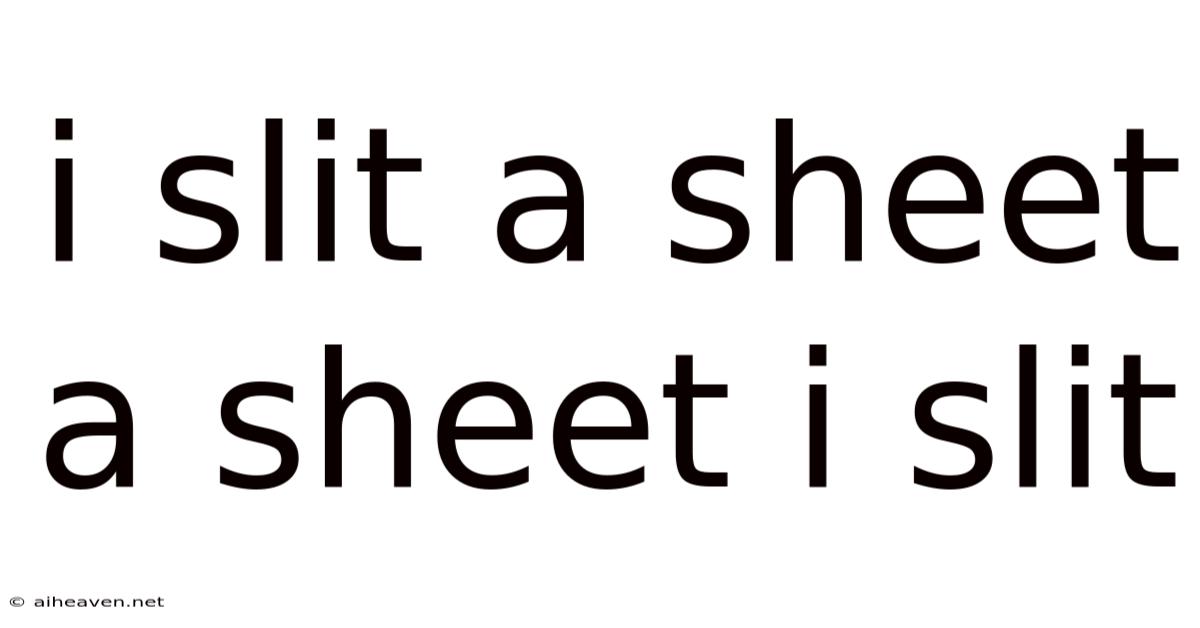
The Curious Case of "I Slit a Sheet, a Sheet I Slit": A Deep Dive into Linguistic Play
The phrase "I slit a sheet, a sheet I slit" is a perfect example of a linguistic palindrome, a clever construction where the sequence of words is reversed to create a mirror-image sentence. This particular phrase is not just a random arrangement of words; it is a meticulously crafted piece of wordplay that demonstrates the fascinating flexibility and symmetry inherent in the English language. At first glance, it may appear as a nonsensical jumble, but upon closer inspection, it reveals itself as a brilliant illustration of syntactic reversal, offering a unique window into the mechanics of grammar and the joy of linguistic experimentation.
Unpacking the Structure: How Does It Work?
To truly appreciate this phrase, one must break down its grammatical architecture. " Here, "I" is the subject performing the action, "slit" is the verb, and "a sheet" is the object receiving the action. Think about it: the sentence is built on a simple subject-verb-object structure in its first half: "I slit a sheet. Worth adding: the second half, "a sheet I slit," is the exact reverse. It begins with the object ("a sheet"), followed by the subject ("I"), and concludes with the verb ("slit"). This reversal is not merely a superficial flipping of words; it is a complete inversion of the sentence's syntactic order Simple, but easy to overlook..
The beauty of this construction lies in its grammatical validity. Here's the thing — both halves of the palindrome are complete and correct English sentences on their own. Practically speaking, the first part states an action, and the second part describes the same action from the perspective of the object. This creates a circular, self-referential loop where the cause and effect are intertwined. The phrase doesn't just read the same forwards and backwards at the word level; it maintains coherent meaning in both directions, which is a rarer and more impressive feat than a simple word-level palindrome like "radar" or "level Still holds up..
Easier said than done, but still worth knowing.
The Broader World of Palindromes
While "I slit a sheet, a sheet I slit" is a syntactic or grammatical palindrome, it belongs to a larger family of linguistic curiosities known as palindromes. A palindrome is a word, phrase, or sequence that reads the same backward as forward. This concept can be applied at different levels:
- Word Palindromes: These are single words like "civic," "radar," "rotator," or "deified." They are the most common and easily recognizable form of palindrome.
- Phrase Palindromes: These involve multiple words, such as "A man, a plan, a canal, Panama!" or "Was it a car or a cat I saw?" These are more complex because they require ignoring punctuation and spaces to be read as a continuous sequence of letters.
- Syntactic Palindromes: This is the category into which our phrase falls. Here, the reversal happens at the level of grammar and word order, not just letters. The meaning is preserved in a mirrored fashion, making it a more sophisticated form of linguistic play.
The study and creation of palindromes, known as palindromy, is a niche hobby and an area of interest within linguistics and recreational mathematics. It highlights the inherent patterns and structures within language, encouraging a playful and analytical approach to words.
A Glimpse into History and Cultural Significance
Palindromes have a long and storied history, appearing in various cultures and languages for centuries. Think about it: the earliest known palindrome is often attributed to a Greek poet named Sotades, who lived in the 3rd century BC and is said to have written a line that reads the same backward. In practice, in ancient Rome, the poet Virgil included palindromic phrases in his work. The form has persisted through the Middle Ages and the Renaissance, often used in Latin texts Small thing, real impact. Took long enough..
The specific phrase "I slit a sheet, a sheet I slit" is a more modern example, popularized in the 20th century. Plus, its simplicity and perfect grammatical symmetry have made it a favorite among linguists, logicians, and lovers of word puzzles. Consider this: it frequently appears in books on linguistics and recreational English to illustrate the concept of syntactic reversal. Also, its cultural significance lies in its ability to surprise and delight, serving as a testament to the creative potential of language. It's the kind of phrase that makes you stop and think about the rules you subconsciously follow when you speak and write Which is the point..
The Science Behind the Fun: Why Are We Drawn to Patterns?
Our fascination with palindromes like "I slit a sheet, a sheet I slit" has a basis in cognitive science. We are wired to look for symmetry, repetition, and order in the world around us, from the bilateral symmetry of our own bodies to the patterns in nature. Plus, the human brain is fundamentally a pattern-recognition machine. When we encounter a palindrome, it triggers a sense of pleasure and satisfaction because it represents a perfect, unexpected symmetry in a system (language) that is typically linear and asymmetric And that's really what it comes down to..
This changes depending on context. Keep that in mind.
This cognitive reward is similar to what we feel when we solve a puzzle or appreciate a work of art. The phrase is surprising because it breaks our expectation of how a sentence should be structured, yet it is satisfying because it resolves into a perfect, logical pattern. This explains why palindromes are not just linguistic curiosities but also tools for engaging the mind, making them valuable in educational settings for teaching grammar and encouraging linguistic awareness.
Practical Applications and Educational Value
While creating a perfect syntactic palindrome is a challenging and enjoyable exercise, the underlying principles have practical applications. Day to day, understanding how sentence structure can be manipulated is crucial for students learning grammar, syntax, and composition. Analyzing phrases like "I slit a sheet, a sheet I slit" can help learners internalize the roles of subjects, verbs, and objects and how they can be rearranged without destroying the core meaning.
Adding to this, the study of palindromes fosters critical thinking and attention to detail. This analytical approach is a valuable skill not only in linguistics but in any field that requires precise communication and logical reasoning. It encourages a closer examination of language, breaking it down into its constituent parts and then reassembling them in novel ways. In a broader sense, engaging with such linguistic play is a form of mental exercise that can enhance vocabulary, improve memory, and spark creativity Small thing, real impact..
Conclusion: The Enduring Charm of Linguistic Mirrors
So, to summarize, "I slit a sheet, a sheet I slit" is far more than a simple tongue twister or a random string of words. Day to day, it is a masterclass in linguistic symmetry, a perfect syntactic palindrome that elegantly demonstrates the reversible nature of grammatical structures. Its charm lies in its combination of simplicity, grammatical correctness, and the cognitive pleasure derived from its perfect mirror-image construction.
This phrase serves as a powerful reminder that language is not a rigid, fixed system but a fluid and malleable tool capable of incredible creativity and playfulness. On top of that, whether you are a seasoned linguist, a student of grammar, or simply someone who enjoys a good puzzle, the enduring appeal of "I slit a sheet, a sheet I slit" is a testament to the timeless fascination with the patterns hidden within the words we use every day. In real terms, it invites us to look beneath the surface of everyday communication and appreciate the involved patterns and rules that make it possible. It is a small, perfect world of mirrored meaning, a linguistic gem that continues to captivate and instruct Less friction, more output..
